

FAQs
California isn’t like other states. The rules on labor, environment, and accessibility are stricter, the penalties are heavier, and the codes change more often. Below are the questions we hear most from commercial property owners across Southern California, with straight answers from a contractor who works under these rules every day. If you have a question we don’t cover here, give us a call. We’re happy to answer it and give you a free estimate on your project.
Does my asphalt project require prevailing wage in California?
If any public funds touch your project, yes. California’s prevailing wage law applies to public works projects over a very low cost threshold, which is much lower than the federal Davis-Bacon equivalent.
Public funds don’t just mean a check from the city. According to the California Department of Industrial Relations, public funds also include tax credits, fee waivers, land sold below market value, government loans, and grants. A privately owned shopping center can still trigger prevailing wage if the project is tied to a public agency requirement.
When prevailing wage applies, every worker on the job, including subcontractors, must be paid the rate set by the DIR’s prevailing wage determinations for that trade and county. Underpayment carries significant per-worker daily penalties, and the prime contractor is jointly liable for subcontractor violations. If you’re not sure whether your project qualifies, ask us before you put it out to bid.
What changed with California prevailing wage in 2026?
As of January 1, 2026, Assembly Bill 889 changed how fringe benefits are calculated on public works projects. Contractors now have to annualize all employer-paid fringe benefits credited toward prevailing wage, using a consistent 12-month period that accounts for both public and private hours worked.
The practice of frontloading fringe benefits on public works hours is gone. So is the old habit of running compliance loose and fixing it during an audit. The DIR and the Division of Labor Standards Enforcement are auditing more aggressively, and the focus is on underpayment, employee misclassification, apprentice ratios, and certified payroll accuracy.
For property owners, this matters because contractors who don’t have their compliance dialed in are going to either bid higher to cover the risk or get hit with penalties mid-project. A contractor who can show certified payroll on demand is a safer bet. Request a free estimate and we’ll walk you through how we handle compliance on your job.
Does prevailing wage apply to the trucks hauling asphalt to my site?
On a public works project, yes. California expanded the definition of public works under Assembly Bill 1851 to include the on-hauling of paving, grading, and fill materials onto a public works site. Drivers delivering hot mix asphalt, base rock, or fill dirt to your project are covered by prevailing wage rules while they’re hauling for that job.
This catches a lot of contractors off guard. They’ll budget prevailing wage for crew labor but assume their material suppliers and trucking are exempt. They’re not. If you’re bidding out a public works commercial paving project in Southern California, ask your contractor to show you how they’re handling hauling compliance. Or send us your scope and we’ll factor it into your estimate the right way.
Do I have to add EV charging stations when I repave my parking lot in California?
It depends on whether your project is treated as new construction, an alteration, or just maintenance. The 2025 CALGreen Code, effective January 1, 2026, significantly expanded EV charging requirements for commercial properties.
For new commercial construction, a percentage of parking spaces must be EV Capable (raceway and panel capacity installed) and a percentage must have actual Level 2 EV chargers installed. The exact numbers depend on building type and parking count. The California Energy Commission and the Building Standards Commission publish the current requirements.
For alterations to existing parking lots, the trigger is whether the work requires a building permit and whether you’re adding or altering parking spaces, electrical systems, or lighting. Routine sealcoating and restriping don’t trigger CALGreen EV requirements. A full reconstruction with new electrical service might.
Once you install actual EV charging stations, accessibility rules under California Building Code Chapter 11B kick in. Even your first EV charging space must be van accessible (12 feet wide and 18 feet long, with a 5 foot access aisle and a path of travel to the building). This is separate from your ADA parking count. If you’re planning EV chargers as part of a larger repave, ask us about your project before you finalize the design.
Do I need a stormwater permit for a parking lot paving project in California?
If your project disturbs one acre or more of soil, yes. You need coverage under California’s Construction General Permit, which requires a Storm Water Pollution Prevention Plan (SWPPP) developed by a Qualified SWPPP Developer.
On smaller jobs, you can usually stay under the SWPPP threshold, but local stormwater ordinances can still apply. Many Southern California municipalities have C.3 or Low Impact Development rules that trigger on projects replacing a relatively small amount of impervious surface. The State Water Resources Control Board publishes the full set of regional requirements.
Before we start a job, we will work with you to ensure the correct permits and BMPs (best management practices) are in place for your specific city and county, whether we pull them directly or coordinate with your general contractor. Protecting your parking lot from water damage also starts with proper drainage planning during paving, so this is a conversation worth having early. Get a free site walk and we’ll tell you what applies to your property.
What license does a commercial asphalt contractor need in California?
For commercial paving work, look for a C-12 (Earthwork and Paving) license from the Contractors State License Board. Some contractors also carry a Class A (General Engineering) license for larger civil projects.
Always verify the license is active before signing a contract. You can look up any California contractor by license number on the CSLB website. Check the bond status, workers’ compensation coverage, and any complaint history while you’re there.
Victory Paving is fully licensed in California (#1093378) and carries the workers’ compensation and general liability insurance required to work on commercial properties across our Southern California service area. You can also see examples of our past work before reaching out. If a contractor hesitates to share their license number or insurance certificates, that’s your sign to move on.
Do I need a permit to repave my commercial parking lot?
In most Southern California cities, a straight resurfacing or overlay over an existing lot doesn’t require a building permit, but it may still require an encroachment permit if any work touches the public right of way.
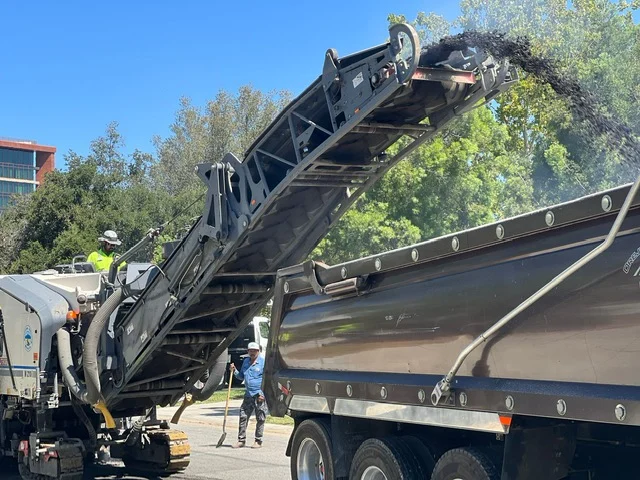
Where permits almost always come into play: full reconstruction, new construction, asphalt milling on larger jobs, grading work, drainage modifications, ADA upgrades, EV charging installations, and any project that increases impervious surface area. Riverside County, San Bernardino County, San Diego County, and the cities within them each have their own permit thresholds and review timelines.
Permit review in major California cities can take months on larger projects. As part of project planning, we will work with you to ensure the correct permits are in place if needed, whether we handle the research and submittal directly or coordinate with your general contractor so nothing slows down the crew once we mobilize. Reach out and we’ll tell you what your specific city is going to want to see.
Why don’t California paving contractors use coal tar sealer?
Coal tar sealer contains high levels of polycyclic aromatic hydrocarbons (PAHs), which are linked to water contamination and health risks. Several California municipalities have banned or restricted coal tar sealers, and the trend is moving toward more bans, not fewer.
Across Southern California, the standard sealcoats we use are asphalt emulsion based, acrylic, or polymer modified. They perform well in our climate, they’re easier on the environment, and they don’t expose property owners to potential liability if a local ban gets enacted later. Here’s a breakdown of the different types of asphalt sealcoating and when each one makes sense.
If a contractor is still pushing coal tar for a commercial lot in California, ask why. The pricing might look better up front, but the regulatory risk and the environmental exposure aren’t worth it on a property you plan to hold. Ask us about your sealcoating options and we’ll recommend the right product for your lot and your climate.
How is California’s ADA standard different from federal ADA?
California layers Chapter 11B of the California Building Code on top of the federal ADA. In many cases, Chapter 11B is stricter. The state also has the Unruh Civil Rights Act and the California Disabled Persons Act, which let plaintiffs recover statutory damages plus attorney’s fees on a per-violation basis. The California Civil Rights Department enforces these state-level protections.
That last part is why California has the highest rate of ADA parking lot lawsuits in the country. A plaintiff doesn’t have to prove actual harm. They just have to show the violation existed.
Common Southern California parking lot violations we see: slope on accessible spaces over 2 percent, missing or faded International Symbol of Accessibility, wrong sign height, missing tow-away warning signs, and access aisles that don’t connect to a compliant path of travel. We offer free on-site ADA parking lot audits across our region, and our complete guide to ADA ramps in California and guide to tactile paving cover the curb ramp side of compliance.
Does Southern California’s climate affect when asphalt can be paved?
Yes. Hot mix asphalt has a placement temperature window, and air temperature, surface temperature, and time of day all factor in. In Temecula, Riverside, San Bernardino, and the rest of the Inland Empire, summer surface temperatures can push asphalt placement schedules to early morning or evening to protect the mix and the crew. We break this down in our guide to how the Inland Empire heat affects your asphalt.
Sealcoating has a stricter window. Most quality sealers need air temperatures above 50 degrees, and dropping below 50 within 24 hours of application is a problem. That’s rarely an issue in Southern California, but it does come into play in higher elevations and during winter storms.
Rain is the bigger variable for us. Our crews monitor the forecast and reschedule when needed. A rushed sealcoat applied ahead of rain is worse than a delayed one. If you’ve already had water damage on your lot, asphalt repair is usually the first step before resealing. Schedule a free assessment and we’ll tell you what your lot needs.
Do paving rules differ between Los Angeles, Riverside, and San Bernardino counties?
Yes, and the differences can be significant. Each county and most cities have their own building codes, permit thresholds, stormwater rules, and ADA enforcement patterns.
Los Angeles County tends to have the strictest stormwater and air quality requirements. Riverside and San Bernardino counties have more variation between cities and tend to move faster on permits, but they still enforce stormwater carefully in watershed-sensitive areas. San Diego County has its own Watershed Protection Ordinance with low impervious surface thresholds. The State Water Resources Control Board maintains the regional permits that each county follows.
A contractor who works across the region every week knows which jurisdiction is going to flag a slope variance and which one is actively prosecuting prevailing wage violations. We cover the full Southern California region from Corona to Moreno Valley to Ontario and adjust our approach city by city. Tell us where your property is and we’ll explain what applies.
Why does asphalt paving cost more in California than other states?
California construction costs run meaningfully higher than the national average. The main drivers are labor rates, material costs, regulatory compliance, and permit timelines.
Skilled trade labor in California costs more than most states, and prevailing wage projects push that even higher. CARB-compliant equipment, SWPPP compliance, ADA upgrades, EV infrastructure, and CEQA review all add real costs to commercial projects. Asphalt prices also move with oil markets, which adds another variable to long-term budgeting.
The flip side is that a contractor who actually meets all those requirements is delivering more value than a bid that ignores them. The cheapest quote on a California commercial paving project is often the one that’s going to leave you exposed. We bid the job that meets code the first time. Learn when to repave your parking lot so you can budget proactively instead of reactively, and request a free estimate whenever you’re ready to talk numbers for your specific project.