

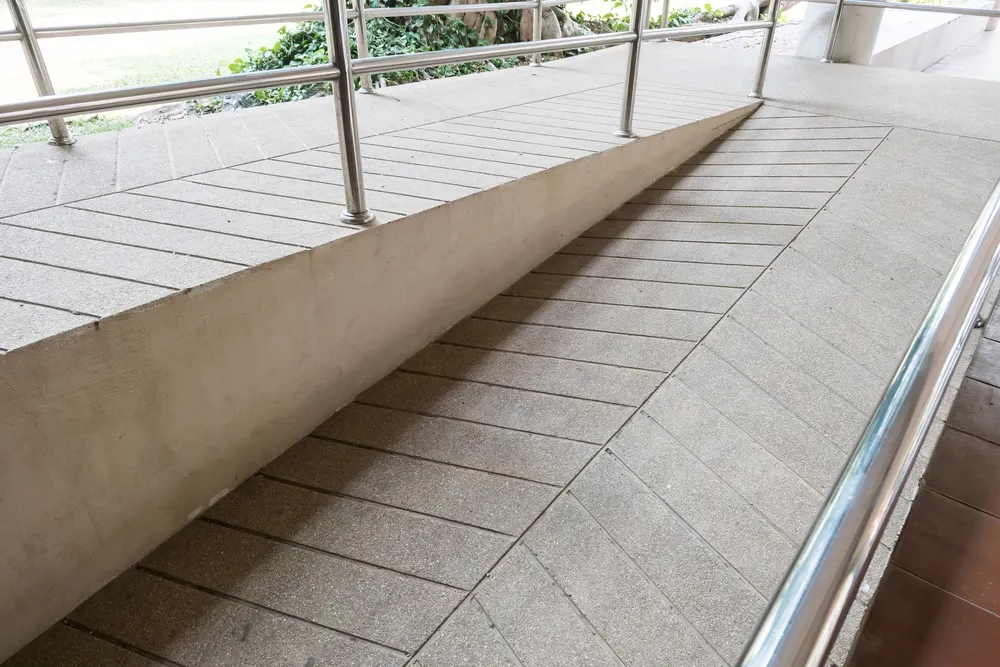
Property owners and managers throughout Southern California face ongoing requirements to maintain ADA-compliant accessibility features. Among the most critical elements are properly designed and constructed concrete ADA ramps. This guide provides the technical specifications, regulatory requirements, and practical considerations needed to ensure your property meets both federal ADA standards and California’s more stringent accessibility codes.
Overview
This comprehensive guide covers everything California property owners need to know about ADA ramp compliance. From technical specifications mandated by California Building Code Title 24 to practical construction considerations, this resource provides the detailed information required to design, build, and maintain code-compliant accessibility ramps. Whether you manage commercial properties, municipal facilities, or homeowner associations, understanding these requirements protects you from liability while ensuring equal access for all visitors and employees.
Understanding ADA and California Accessibility Laws
The Americans with Disabilities Act (ADA) established baseline accessibility standards for public accommodations and commercial facilities. In California, these federal requirements are supplemented and often exceeded by the California Building Code (CBC) Title 24, Chapter 11B. Property owners must comply with whichever standard is more strict.
California’s Division of the State Architect (DSA) enforces Title 24 accessibility standards. The state requires that all new construction, alterations, and additions to public accommodations meet these enhanced requirements. Failure to comply can result in lawsuits, penalties from the California Department of Fair Employment and Housing, and costly retrofits.
When Are ADA Ramps Required?
ADA ramps are mandatory whenever a vertical level change exceeds one-half inch at an accessible route. This applies to:
- Building entrances and exits
- ADA parking lots connecting to buildings
- Concrete sidewalks with grade changes
- Pathways to amenities like pools, mailboxes, or common areas
- Any route designated as accessible
California Building Code Section 11B-405 defines when a slope becomes a ramp rather than a walking surface. Any running slope steeper than 1:20 (5 percent) is classified as a ramp and must meet all ramp specifications.
Technical Specifications for ADA Ramps in California
Running Slope Requirements
The running slope is the grade along the direction of travel. California requirements follows these standards:
Table 1: Maximum Running Slope Standards
| Construction Type | Maximum Slope | Rise Allowed |
| New Construction | 1:12 (8.33%) | 30 inches max per run |
| Existing Facilities (space limited) | 1:10 (10%) | 6 inches max per run |
| Existing Facilities (severe constraints) | 1:8 (12.5%) | 3 inches max per run |
For most commercial applications, the 1:12 slope is standard. This means for every 12 inches of horizontal run, the ramp can rise 1 inch. A ramp with a 30-inch rise therefore requires 30 feet of horizontal distance.
Cross Slope Standards
The cross slope runs perpendicular to the direction of travel. California Building Code 11B-405.3 mandates that cross slopes cannot exceed 1:48 (2.08 percent). This prevents wheelchairs from drifting sideways during use.
Width Requirements
CBC Section 11B-405.5 specifies minimum clear width between handrails:
- Standard ramps: 48 inches minimum
- Ramps in existing buildings (alterations): 36 inches minimum where space is limited
The 48-inch standard accommodates wheelchair users passing each other or turning around. Property owners should plan for this width during design to avoid noncompliance.
Rise and Run Limitations
Table 2: Maximum Rise Per Ramp Run
| Slope Ratio | Maximum Rise | Horizontal Run Required |
| 1:12 | 30 inches | 30 feet |
| 1:16 | 30 inches | 40 feet |
| 1:20 | No limit | Classified as walkway |
California requires a level landing whenever a ramp run exceeds 30 inches of vertical rise. This gives wheelchair users rest areas and space to maneuver safely.
Landing Requirements
Landings are level platforms at the top, bottom, and direction changes of ramps. They serve critical safety and maneuverability functions.
Top Landing Specifications
CBC Section 11B-405.7.3 requires:
- Minimum 60 inches long in direction of travel
- At least as wide as the ramp itself
- Maximum slope of 1:48 in any direction
- Must be level if a door swings onto the landing
Bottom Landing Specifications
- Minimum 72 inches long in direction of travel
- At least as wide as the ramp itself
- Maximum slope of 1:48 in any direction
Intermediate Landings
Required when:
- Ramp changes direction
- Ramp run exceeds 30 inches of rise
- Doorways are present along the ramp
Specifications:
- Minimum 60 inches by 60 inches for straight ramps
- Minimum 60 inches by 72 inches where ramps change direction
Handrail Requirements
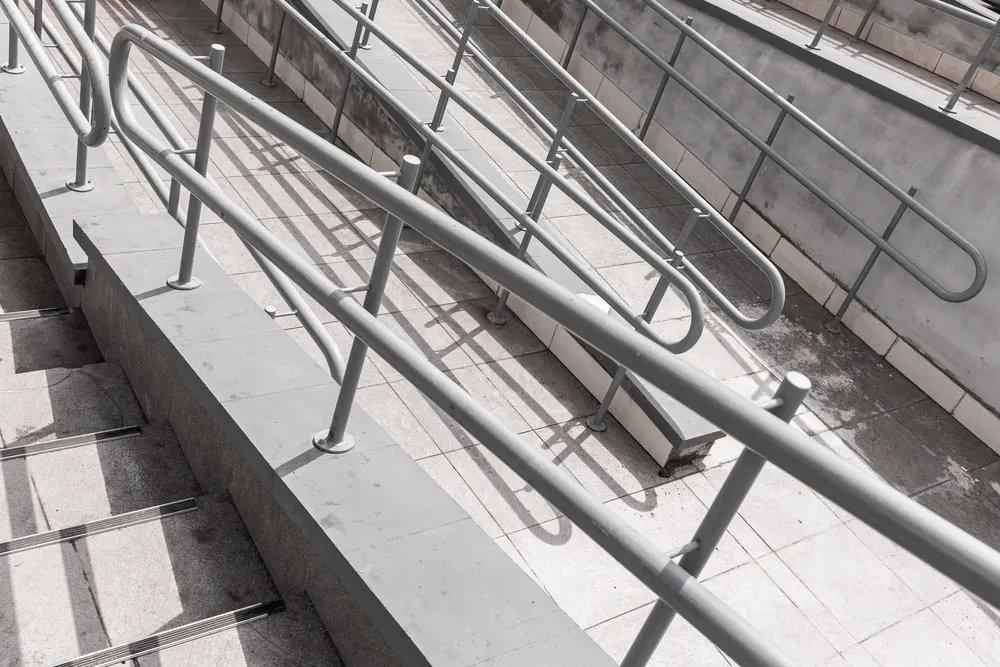
CBC Section 11B-405.8 mandates handrails on both sides of any ramp with a rise greater than 6 inches.
Table 3: Handrail Specifications
| Component | Requirement |
| Height | 34 to 38 inches above ramp surface |
| Gripping Surface | Circular: 1.25 to 2 inches diameter |
| Non-circular: 4 to 6.25 inch perimeter | |
| Extension Beyond Top | Minimum 12 inches parallel to ground |
| Extension Beyond Bottom | Minimum 12 inches plus ramp width |
| Clearance from Wall | 1.5 inches minimum |
| Continuity | Must be continuous within full length |
Handrails must support a concentrated load of 250 pounds applied in any direction. They should be smooth, without sharp edges or abrasive surfaces that could injure users.
Edge Protection
California requires edge protection on both sides of ramps to prevent wheelchairs, crutches, or canes from slipping off the edge.
Options include:
- Curb: Minimum 4 inches high (California exceeds federal 2-inch requirement). See our curbs and gutters services.
- Barrier: Extends at least 2 inches above ramp surface
- Extended Surface: Ramp surface extends 12 inches beyond handrail
CBC Section 11B-405.9.2 specifies these protections must be continuous along the full length of the ramp run.
Surface Requirements
Texture and Materials
Ramp surfaces must be:
- Firm: Does not compress significantly under typical loads
- Stable: Maintains uniform surface under normal conditions
- Slip-resistant: Provides adequate friction in dry and wet conditions
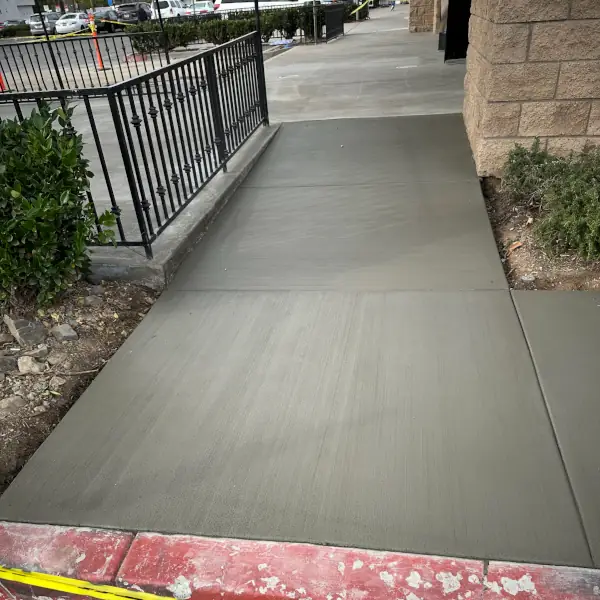
California prohibits highly polished or slippery surfaces. Concrete is the most common material due to its durability and ability to meet these standards. A broom finish or similar texture provides adequate slip resistance.
Drainage
Proper drainage prevents standing water that creates slip hazards and accelerates deterioration. Ramps should be crowned or sloped minimally to direct water away without exceeding cross-slope limits.
Detectable Warning Surfaces
Where ramps connect to vehicular areas without curbs, California requires detectable warning surfaces. CBC Section 11B-705 specifies:
- Truncated domes in a square grid pattern
- Dome diameter: 0.9 inches (nominal)
- Dome spacing: 2.35 inches (nominal) center to center
- Color contrast with surrounding surface
- Extends full width and 24 to 36 inches in direction of travel
These tactile indicators alert visually impaired pedestrians to hazardous vehicle areas. For complete accessibility, proper parking lot striping ensures clear designation of accessible spaces.
Common Noncompliance Issues
Slope Errors
Even minor miscalculations cause failures. A ramp measured at 8.5 percent slope (1:11.76) exceeds the 8.33 percent maximum and will not pass inspection.
Insufficient Landing Size
Landings measuring 58 inches instead of the required 60 inches constitute violations. Precision during layout and construction is essential.
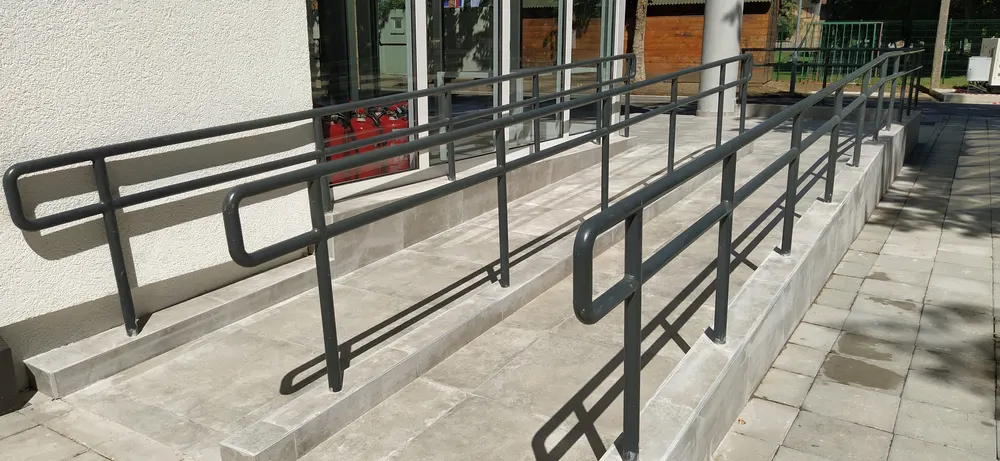
Missing or Improper Handrails
Common errors include:
- Handrails terminating at ramp ends instead of extending properly
- Incorrect mounting height
- Insufficient grip diameter
- Lack of continuity along runs
Surface Problems
Issues include:
- Cracks or spalling creating tripping hazards
- Excessive roughness or smoothness
- Cross slopes exceeding 2 percent
- Standing water from poor drainage
Inadequate Edge Protection
Curbs less than 4 inches high or gaps in edge protection create serious safety hazards and code violations.
Permitting and Inspection Process
Most California jurisdictions require:
- Plan Review: Submit detailed construction drawings showing all dimensions, slopes, materials, and specifications
- Building Permit: Obtain approval before beginning work
- CASp Review: Many cities require Certified Access Specialist review for commercial projects
- Inspections: Schedule inspections at key construction phases
- Final Approval: Obtain certificate of occupancy or compliance
The California Commission on Disability Access maintains lists of CASp professionals who can review plans and certify compliance.
Material Considerations
Concrete
Advantages:
- Meets all durability requirements
- Accepts various finishes for slip resistance
- Long service life with proper installation
- Familiar to inspectors and contractors
Standard specification: 3,000 PSI minimum compressive strength with proper reinforcement. Learn more about our concrete pad services.
Asphalt
Less common for ADA ramps due to:
- Difficulty maintaining precise slopes in hot weather
- Surface degradation over time
- Challenges meeting slip resistance when new
- More frequent maintenance requirements
Cost Factors
California ADA ramp construction costs vary based on:
Table 4: Cost Variables
| Factor | Impact on Cost |
| Slope ratio | Gentler slopes require more material and space |
| Site preparation | Excavation, grading, and drainage work |
| Concrete thickness | 4 to 6 inches standard, thicker for heavy loads |
| Handrail material | Powder-coated steel vs. stainless steel |
| Site accessibility | Equipment access limitations increase labor |
| Demolition | Removing existing noncompliant structures |
Average costs in Southern California range from $3,500 to $8,000 for standard commercial ramps, with complex installations exceeding $15,000.
Maintenance Requirements
Regular parking lot maintenance preserves compliance and safety:
Monthly: Visual inspection for cracks, surface damage, loose handrails, or drainage problems
Quarterly: Clean surfaces, check handrail tightness, verify edge protection integrity
Annually: Measure slopes with precision instruments, assess structural condition, document compliance
As Needed: Repair cracks immediately, repaint contrasting surfaces, replace damaged components
Liability and Legal Considerations
California property owners face significant liability for noncompliant accessibility features. The Unruh Civil Rights Act allows damages of $4,000 per violation plus attorney fees. Serial plaintiffs actively pursue accessibility lawsuits throughout California.
Beyond lawsuit risk, the California Department of Fair Employment and Housing can investigate complaints and order compliance. Local building departments may issue citations and stop-work orders.
Proactive compliance protects against:
- Civil lawsuits from disabled individuals
- State enforcement actions
- Insurance claim denials
- Reputation damage
- Expensive emergency retrofits
Working with Qualified Contractors
Selecting an experienced contractor ensures proper installation. Look for:
- Valid California contractor license (C-8 for concrete)
- Current liability and workers compensation insurance
- Experience with ADA projects
- Knowledge of CBC Title 24 requirements
- References from completed accessibility projects
- Familiarity with local permitting processes
Request detailed proposals showing slope calculations, material specifications, and compliance documentation.
Victory Paving’s Approach to ADA Compliance
Victory Paving constructs code-compliant ADA ramps throughout Southern California. Our commercial paving process includes:
- Site Assessment: Detailed evaluation of existing conditions and access requirements
- Design Planning: Precise slope calculations and layout to meet all CBC specifications
- Permit Coordination: Preparation of compliant plans and permit applications
- Quality Construction: Experienced crews using proper materials and techniques
- Inspection Support: Coordination with building officials and CASp reviewers
- Documentation: Providing as-built drawings and compliance certification
We serve commercial properties, municipalities, homeowner associations, andproperty management companies across Temecula, Murrieta, Riverside, Corona, and surrounding areas.
Conclusion
ADA ramp compliance requires attention to detailed specifications and California’s enhanced accessibility standards. Property owners must understand running slopes, cross slopes, landing dimensions, handrail requirements, edge protection, and surface standards to achieve compliant installations.
Working with qualified contractors who understand CBC Title 24 requirements ensures projects pass inspection and provide safe, dignified access for all users. The investment in proper design and construction prevents costly retrofits, reduces liability exposure, and demonstrates commitment to equal access.
For professional ADA ramp design and installation in Southern California, contact Victory Paving. We bring technical expertise, quality craftsmanship, and thorough knowledge of California accessibility requirements to every project.
References:
- California Building Code, Title 24, Part 2, Volume 1, Chapter 11B
- California Code of Regulations, Title 24, Part 2, Section 11B-405
- California Division of the State Architect, Accessibility Regulations
- California Commission on Disability Access
Call Victory Paving today For ADA-compliant ramp installation throughout Southern California, request a consultation and quote today.