

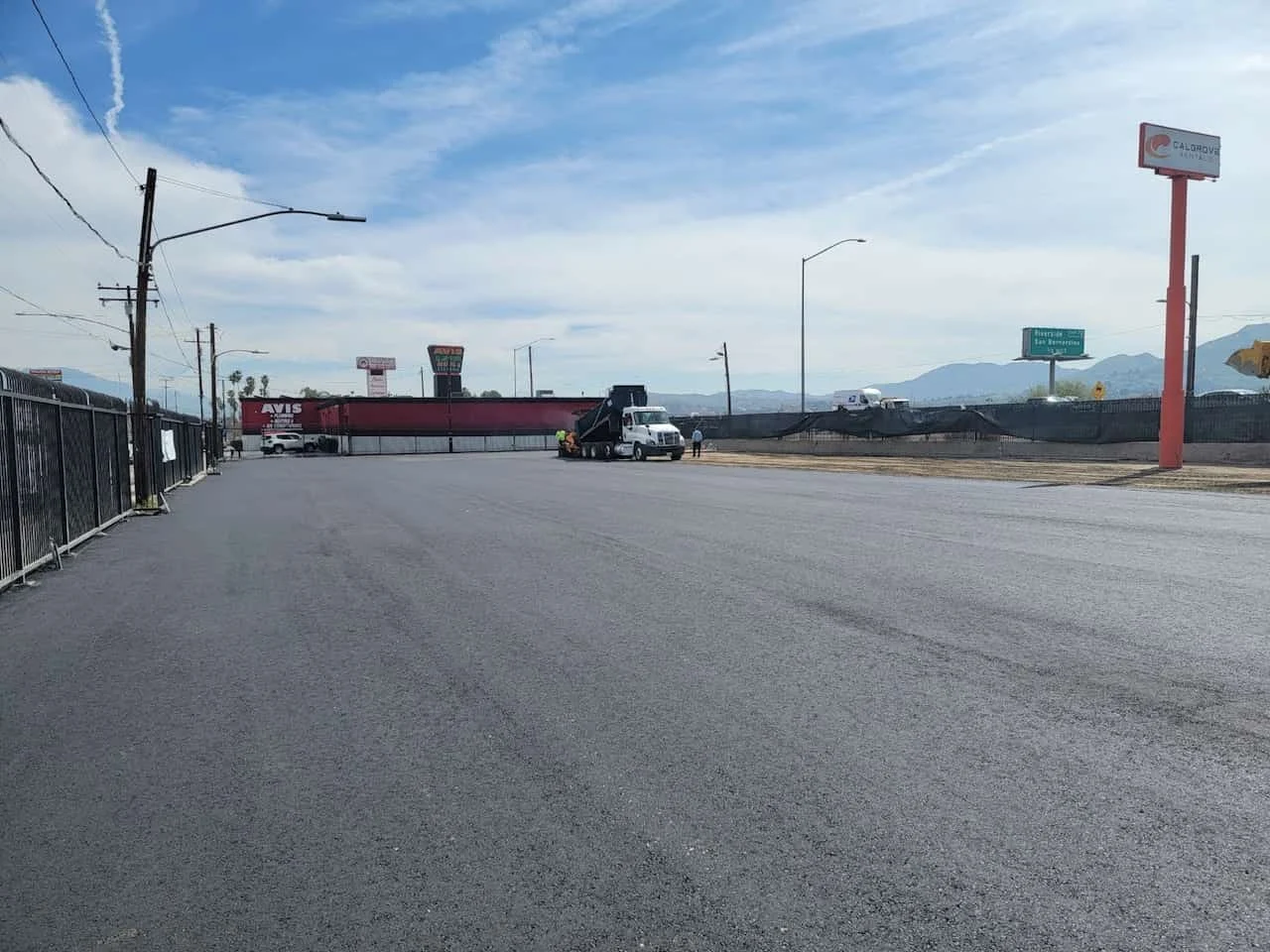
If you’re planning a new parking lot, expanding an existing one, or facing a full replacement, you’re going to hit the same question every commercial property owner in the Inland Empire deals with: asphalt or concrete?
Both materials work. Both have trade-offs. But the right answer depends on your property type, your budget timeline, how much heavy traffic the lot sees, and what the Inland Empire climate is going to do to the surface over the next 15 to 25 years.
Here’s an honest breakdown based on what we see working (and failing) across properties from Riverside to Murrieta to San Bernardino.
The Basics: What Each Material Actually Is
Asphalt is a mix of aggregate (crushed stone, sand, gravel) bound together with a petroleum-based binder. It’s flexible, relatively quick to install, and can be driven on within a day or two of placement. It’s the standard material for commercial parking lots across most of the country.
Concrete is a mix of aggregate bound with Portland cement and water. It’s rigid, takes longer to cure (typically 7 days before it can handle traffic), and costs more upfront. But it handles certain conditions better than asphalt, especially sustained heavy loads.
In Southern California, you’ll see both on commercial properties. The question isn’t which is better overall. It’s which is better for your specific situation.
How They Handle Inland Empire Heat
Asphalt and Heat
Asphalt absorbs heat. On a 110-degree day in Fontana or Moreno Valley, the surface temperature of an asphalt lot can hit 150 degrees or higher. That softens the binder, which can lead to rutting in areas with heavy or slow-moving traffic. Over time, UV exposure oxidizes the surface and makes it brittle, which is why sealcoating every two to three years is essential in this climate.
The upside: asphalt’s flexibility means it handles thermal expansion and contraction better than rigid materials. It bends instead of cracking, at least as long as the binder stays healthy.
Concrete and Heat
Concrete reflects more heat than asphalt, so surface temperatures run cooler. It doesn’t soften or rut under high heat the way asphalt can. For properties that deal with slow-moving heavy traffic, like distribution centers or loading docks, that’s a real advantage.
The downside: concrete is rigid. When temperatures swing from 60 degrees overnight to 110 by mid-afternoon (a normal day in the IE from June through September), that thermal stress goes somewhere. It goes into the joints and the slab edges. If the joints aren’t properly cut and sealed, you get cracking that’s expensive to repair.
Cost Comparison: Upfront and Long-Term
| Factor | Asphalt | Concrete |
| Upfront cost per sq ft | $3 to $7 | $6 to $12 |
| Installation time | 1 to 2 days to drive on | 7+ days to cure |
| Expected lifespan (IE climate) | 15 to 20 years with maintenance | 20 to 30 years with maintenance |
| Ongoing maintenance | Sealcoat every 2-3 yrs, crack sealing | Joint sealing, occasional slab replacement |
| Repair ease | Simple. Cut, remove, patch, drive on. | Harder. Full slab removal and pour. |
| Heavy traffic tolerance | Moderate. Can rut under sustained loads. | High. Handles heavy loads well. |
The short version: asphalt costs less to install and is easier to repair. Concrete costs more upfront but lasts longer and handles heavy loads better. Your total cost over 20 years depends on how well you maintain either one.
When Asphalt Is the Right Call
For most standard commercial parking lots in the Inland Empire, asphalt is the practical choice. Here’s where it makes the most sense.
Retail centers, office parks, and multi-tenant lots where the majority of traffic is passenger vehicles. These lots see high volume but low weight per vehicle. Asphalt handles that well, and the lower upfront cost means you can invest the savings into a solid maintenance program that keeps it performing for 15 to 20 years.
Properties where budget matters now. If you need to resurface a large lot and cash flow is tight, asphalt gives you a quality surface at roughly half the upfront cost of concrete. Combine that with scheduled sealcoating and crack sealing, and you’ll get strong long-term value.
Any situation where you might need to cut into the surface later for utility work, drainage adjustments, or layout changes. Asphalt is far easier to saw-cut, remove, and patch than concrete.
When Concrete Makes More Sense
Concrete earns its higher price tag in specific situations where asphalt would struggle.
Loading docks, dumpster pads, and drive aisles with regular truck traffic. These areas take concentrated, repeated loads that asphalt can’t handle long-term without rutting. A concrete apron at a loading zone will outlast asphalt in that same spot by years.
Fire lanes where heavy fire apparatus needs a stable surface. Many municipalities in Riverside and San Bernardino counties require or recommend concrete for fire lanes because of the weight involved.
ADA ramps, curbing, and sidewalks. These are almost always concrete, both for durability and because concrete meets the slip-resistance and accessibility standards more consistently than asphalt in these applications.
The Hybrid Approach: Using Both Materials Together
On a lot of the commercial properties we work on across the IE, the smartest approach isn’t choosing one material over the other. It’s using both where they perform best.
That means asphalt for the main parking field where cars drive and park, and concrete for high-stress zones like dumpster pads, loading areas, drive-through lanes, and ADA-accessible paths. You get the cost efficiency of asphalt where it works and the durability of concrete where you need it.
This is especially common at shopping centers, healthcare facilities, and distribution properties. The key is planning the transitions between materials properly so you don’t get separation or drainage issues at the seams.
What the Inland Empire Soil Means for Your Decision
Soil conditions across the Inland Empire vary, but expansive clay soils are common in areas like Moreno Valley, Perris, and parts of Riverside. These soils swell when wet and shrink when dry, creating movement that affects any surface material on top.
Asphalt has an advantage here because it’s flexible enough to absorb minor soil movement without cracking. Concrete, being rigid, is more likely to crack when the ground shifts underneath. That said, proper base preparation, including compaction and adequate aggregate depth, matters more than the surface material in dealing with expansive soils.
In sandy soil areas, like parts of the San Bernardino Valley, base stability is critical for both materials. Without a well-compacted aggregate base, neither asphalt nor concrete will hold up. What’s underneath matters more than what’s on top.
Making the Decision for Your Property
There’s no universal answer. But here’s a practical framework.
Ask yourself three questions. First, what kind of traffic does the lot handle? If it’s mostly cars, asphalt works well. If you have regular heavy vehicles, consider concrete for those zones. Second, what’s your budget timeline? If you need to manage cost now and can commit to maintenance, asphalt makes sense. If you can invest more upfront for less maintenance over time, concrete is worth considering. Third, are you planning any changes to the layout in the next 5 to 10 years? If so, asphalt’s easier to modify.
The best way to decide is to have a contractor who works with both materials walk your property and give you an honest assessment. Not every contractor does both, which can bias the recommendation you get.
Get a Straight Answer for Your Property
Victory Paving handles both asphalt and concrete for commercial properties across the Inland Empire. We’ll walk your property, look at traffic patterns and soil conditions, and tell you what makes sense. No pressure toward one material over the other.Request a free estimate or call 760-367-8047 to set up a site visit. We’ll give you the information you need to make a smart decision for your property.