

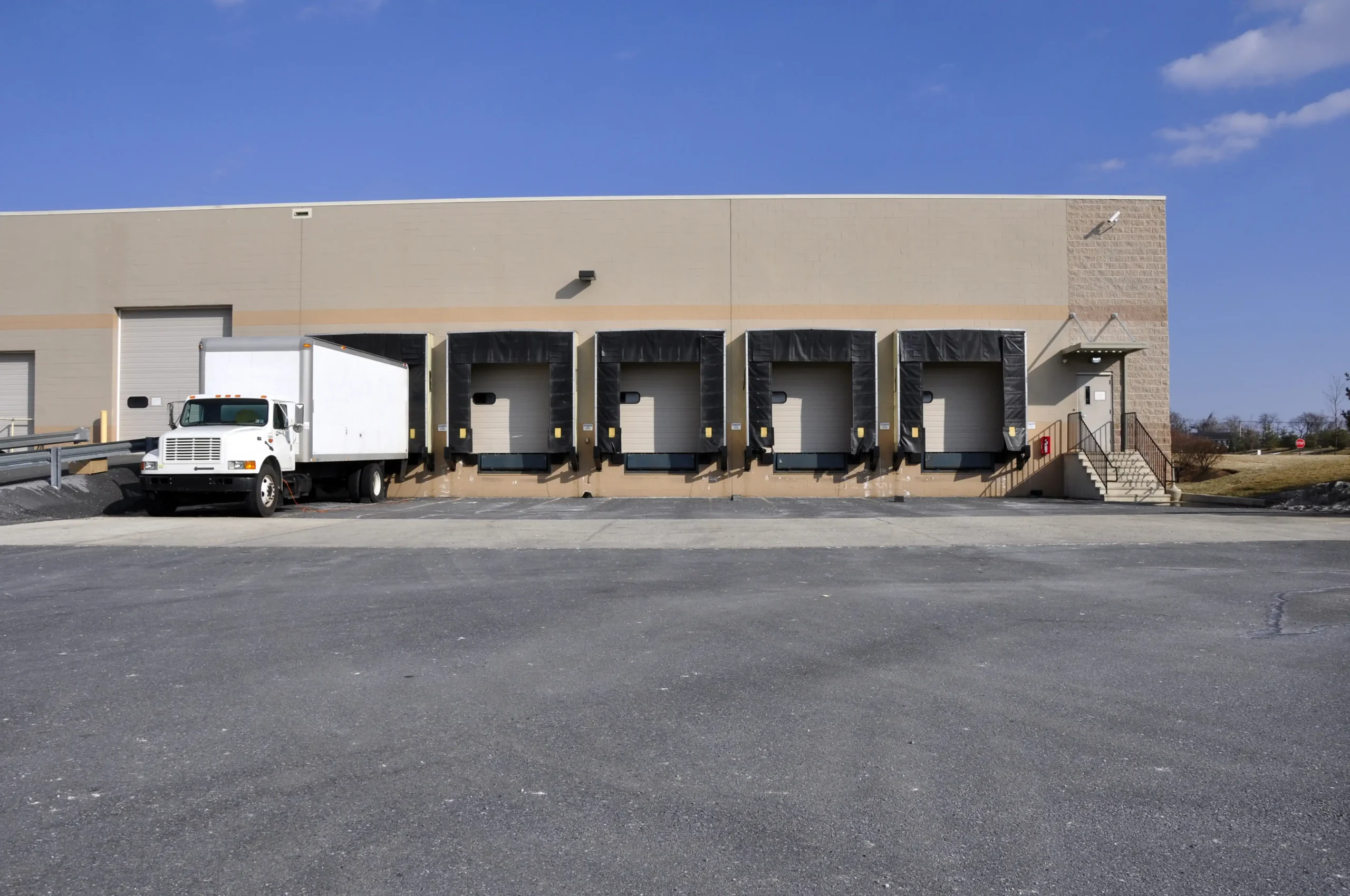
Most loading docks and heavy equipment pads in Temecula tend to call for concrete somewhere in the 4,000 to 5,000 PSI range, poured roughly 6 to 8 inches thick, usually with some form of steel reinforcement and load-transfer dowels at the joints. That range covers a lot of the forklift, box truck, and semi-trailer traffic you commonly see. Your actual spec, though, can shift depending on how the pad will be used, how often it will see heavy loads, and what the soil underneath looks like.
Getting these numbers wrong tends to be expensive. An underbuilt slab may crack at the joints, spall under forklift wheels, and can potentially fail within a few years rather than lasting the decades most owners are hoping for. In this guide we walk through PSI, thickness, and reinforcement in general terms so you can start to think about what a dock built for real-world loads might look like.
Why Loading Docks Often Need Different Concrete Than Parking Lots
Loading docks generally fail for a different reason than a parking lot does. A standard parking lot tends to spread a car’s weight across four tires over a wide area. A dock, on the other hand, often concentrates significant force onto very small contact points, such as a loaded forklift wheel, a trailer’s landing gear, or the corner of a shipping container.
According to the American Concrete Institute’s ACI 302.1R guide for floor and slab construction, floors around loading docks tend to crack in part because of their configuration and the restraints acting on them. So it generally makes sense to engineer dock concrete with point loads and repeated impact in mind, not just total tonnage.
Point Loads vs. Distributed Loads
A distributed load spreads weight over a large surface. A point load tends to drive it through a smaller one. A forklift may carry less total weight than a delivery truck yet still do more damage, largely because that weight often rides on hard, narrow wheels pressing down on a few square inches. Concrete that handles distributed loads reasonably well can, in some cases, crack under concentrated point loads.
Abrasion, Impact, and Turning Stress
Docks tend to take punishment a parking lot rarely sees. Steel forklift wheels can grind at the surface (abrasion). Dropped pallets and hard braking may hammer it (impact). Forklifts pivoting in place can twist the top layer (turning stress).
Repeated heavy vehicle traffic often wears a dock down faster than owners expect, which is one reason dock slabs are usually built with both fairly high compressive strength and a hard, abrasion-resistant surface finish. Strength alone tends not to fully protect against wear.
PSI Explained: What the Number Generally Means
PSI stands for pounds per square inch. It measures compressive strength, roughly meaning how much crushing pressure concrete can take before it fails. A 4,000 PSI slab can, in theory, withstand somewhere around 4,000 pounds of force pressing on each square inch under lab conditions.
Compressive Strength in Plain English
Think of PSI as a kind of crush rating for concrete. Higher PSI concrete usually uses more cement and a lower water-to-cement ratio, which tends to produce a denser, harder material. Concrete is typically tested at 28 days, which is the common industry benchmark for full design strength. So a “4,500 PSI mix” generally refers to the strength the concrete is designed to reach after curing for about 28 days.
Typical PSI Ranges by Use Case
The table below shows the ranges most contractors work within by application. Loading docks and heavy equipment areas tend to sit toward the top end because of the point loads and abrasion they often face.
| Application | Typical PSI Range | Notes |
|---|---|---|
| Residential sidewalks and patios | Around 3,000 PSI | Generally light foot traffic |
| Standard commercial slabs | Roughly 3,500 to 4,000 PSI | Cars and lighter vehicle traffic |
| Loading docks and forklift areas | Roughly 4,000 to 5,000 PSI | Point loads, abrasion, impact |
| Heavy equipment and container yards | Often 4,500 to 5,000+ PSI | Highest concentrated loads |
Industry guidance from ACI 302.1R and various industrial flooring specialists tends to place most industrial floors somewhere in the 4,000 to 5,000 PSI band. It’s also common to see flexural strength (bending resistance) specified in a range that might land between roughly 550 and 700 PSI, since concrete with high compressive strength but low flexural strength can still crack under concentrated wheel loads in some situations.
Why Higher PSI Alone Does Not Necessarily Mean a Stronger Slab
More PSI is not automatically better, and that’s the point that tends to surprise owners the most. A 5,000 PSI mix generally creates more heat while curing, may shrink faster, and can potentially crack more aggressively than a well-designed 4,000 PSI slab if it isn’t managed carefully.
Real-world durability tends to come from the whole system working together: a suitable PSI, an appropriate thickness, appropriate reinforcement, a well-compacted subgrade, and thoughtfully placed joints. Chasing one number while ignoring the rest is arguably one of the more common ways a dock slab fails earlier than expected. Most experienced contractors think of every dock as a balanced system rather than a single number.
Slab Thickness and Reinforcement for Heavy Loads
Generally speaking, thickness carries the load, and reinforcement tends to hold the slab together once cracks form. Most industrial concrete floors run somewhere between 6 and 12 inches thick depending on what drives across them. For docks in the Temecula area, 6 to 8 inches is a fairly common working range, with heavier applications often going thicker.
Recommended Thickness by Equipment Type
Use the ranges below as a general starting point. Final numbers are usually confirmed through a load analysis for the specific equipment and traffic frequency involved.
| Equipment / Use | Typical Slab Thickness | Reinforcement |
|---|---|---|
| Delivery vans and light trucks | Around 5 to 6 inches | Wire mesh or fiber |
| Box trucks and moderate forklift | Roughly 6 inches | Rebar or heavy mesh |
| Semi-trailers and standard forklift | Often 6 to 8 inches | Rebar grid plus dowels |
| Heavy forklift or high-frequency | 8 inches or more | Rebar grid plus dowels |
| Dumpster pads | Roughly 6 to 8 inches | Rebar grid |
Concrete dumpster pads deserve a mention because they are quietly one of the tougher surfaces on most commercial properties. A loaded front-load garbage truck can concentrate several tons on a fairly small pad while lifting and slamming a heavy bin, so pads like these are commonly specified in the 6 to 8 inch range of reinforced concrete even though they look modest.
Rebar vs. Wire Mesh vs. Fiber Reinforcement
Reinforcement doesn’t really stop concrete from cracking in the strict sense. What it tends to do is hold cracks tight so they stay hairline rather than spreading. Here is roughly how the three main options compare:
- Rebar (reinforcing steel bar): Generally the strongest option. A grid of steel bars can carry heavy, concentrated loads and is often the default for docks and heavy equipment slabs.
- Welded wire mesh: A lighter steel grid. Reasonable for lighter commercial slabs but often considered under-built for a true heavy-equipment dock.
- Fiber reinforcement: Fibers mixed into the concrete tend to help control fine surface cracking. It’s often used alongside rebar rather than as a replacement in heavy-load areas.
Dowels and Load Transfer at Joints
Joints are usually where dock slabs live or die. When a forklift rolls across a joint between two slabs, smooth steel dowel bars can transfer load from one slab to the next so neither edge drops or chips. Without dowels, joint edges may break down under repeated wheel traffic in a way sometimes called faulting.
ACI guidance generally calls for smooth, properly aligned dowels set in baskets to keep them parallel, which allows the joint to open as concrete shrinks while still transferring load. On a heavier dock, dowelled joints are usually treated as standard rather than optional.
Site Conditions in Temecula That Can Affect Your Spec
The concrete mix is only part of the picture. What sits under the slab tends to matter just as much, and Temecula has a local complication that’s usually worth planning around from the start.
Expansive Clay Soils and Subgrade Prep
Portions of the Temecula Valley are known to contain expansive clay, similar to the clay-rich soils that support the region’s vineyards. Areas around French Valley, Redhawk, and Old Town are among those often mentioned in this context. Expansive clay tends to swell when wet and shrink when dry, which can exert real force on anything built on top of it.
For a loading dock, that seasonal movement can potentially crack an otherwise well-built slab from below. The usual approach involves the subgrade: proper soil evaluation, thorough subgrade compaction, and where appropriate, a stabilized or engineered base before any concrete is poured. Expansive clay is typically classified in geotechnical terms by a high plasticity index, and a soil test usually gives a clearer sense of what base preparation a particular site might need.
Temperature Swings and Curing in the Inland Valleys
Inland Temecula tends to see hot summer afternoons and cool nights. Concrete poured and cured near 73 degrees Fahrenheit is generally the baseline for most published strength data. Above roughly 90 degrees, concrete may stiffen fairly quickly, sometimes within 45 to 60 minutes, and rapid surface drying can raise the risk of cracking.
This is part of why pour timing and curing method tend to matter locally. Planning around the heat, using appropriate admixtures, and keeping the slab moist during early curing can generally help produce a stronger, longer-lasting dock than a slab poured at the wrong time of day.
Joints, Drainage, and Dock Approach Details
Even a well-specified slab tends to need appropriate joints and drainage to hold up over time. These details often separate a dock that ages gracefully from one that spiders with cracks after a couple of seasons.
Control Joints and Spacing for Thick Slabs
Concrete shrinks as it cures, losing something in the neighborhood of 1/16 inch per 10 feet. Control joints are planned weak points that tend to force this shrinkage to crack along a controlled line rather than randomly across the surface. Joint panels are usually kept close to square, with a 1-to-1 aspect ratio often preferred, and long, thin, or L-shaped panels are generally avoided because they can invite random cracking.
Slope and Drainage at Dock Aprons
Standing water is a slow killer for dock concrete and can also be a safety issue for workers. The apron in front of a dock is typically sloped to drain water away from the building and the pit, which helps keep water off the slab and out of the joints. Proper slope also tends to reduce pooling under trailer tires and tracking into the warehouse.
The Asphalt-to-Concrete Transition
Most docks involve a concrete apron meeting an asphalt yard, and that seam is often a classic failure point. Trucks tend to brake, turn, and accelerate right where the two materials meet, so the transition usually needs a proper thickened edge and a clean joint to help prevent the asphalt from shoving or the concrete edge from chipping.
Choosing between concrete and asphalt for a commercial surface generally comes down to load, and the two typically have to be detailed to work together. It’s common to pour commercial concrete slabs and lay commercial asphalt paving around them, so the dock and the yard are designed together as one system rather than pulling apart later.
How a Loading Dock Project Is Generally Specified
A durable dock tends to be the product of a process rather than a single number pulled off a chart. Here is roughly how a loading dock specification usually comes together:
- Site assessment: Evaluating the equipment, traffic frequency, and how the dock will actually be used.
- Soil evaluation: Testing the subgrade for expansive clay and bearing capacity, then planning base preparation.
- Load analysis: Matching slab thickness and reinforcement to the real point loads the surface will likely see.
- Mix design: Specifying PSI, flexural strength, and finish appropriate for the loads and local climate.
- Placement and curing: Pouring with appropriate joints and dowels, then curing carefully for full strength.
Victory Paving is a licensed California contractor (CSLB #1093378) serving Temecula and the broader Inland Empire, with experience on commercial slabs for distribution centers and manufacturing facilities, as well as retail and mixed-use projects. To start scoping your loading dock or heavy equipment area, feel free to request a free estimate or call 760-367-8047.
Frequently Asked Questions
How thick should a concrete pad generally be for a forklift or semi truck?
A concrete pad for forklift and semi-truck traffic is typically somewhere in the 6 to 8 inch range with steel reinforcement in most cases. Lighter delivery vehicles may only need 5 to 6 inches, while heavier or high-frequency forklift areas commonly run 8 inches or more. Reinforcement and dowelled joints tend to be considered standard once you’re working in these thicknesses.
Is 3,000 PSI concrete strong enough for heavy equipment?
Generally speaking, 3,000 PSI concrete is more commonly rated for sidewalks and light residential use rather than heavy equipment. Loading docks and equipment areas usually call for something in the 4,000 to 5,000 PSI range to help resist the concentrated point loads and abrasion that heavy machinery tends to create. Relying on 3,000 PSI in these settings often increases the risk of early cracking and surface failure.
How long before heavy trucks can drive on new concrete?
It’s generally recommended that heavy trucks and loaded equipment stay off new concrete for roughly the full 28 days it takes to reach design strength. Concrete typically reaches around 70% of its strength in the first 7 days or so, which is often enough for light vehicle traffic. However, applying concentrated heavy loads too early tends to cause micro-cracks that can shorten the slab’s useful life.
Should a loading dock be concrete or asphalt?
In most cases, a loading dock is best built in concrete. Concrete generally tends to resist the point loads, turning stress, and abrasion from forklifts and trailers that would likely rut and deform asphalt over time. Asphalt is often a reasonable choice for the surrounding drive lanes and yard, which is why many properties combine a concrete dock apron with an asphalt lot.
Do Temecula soils really affect concrete specs?
In many cases, yes. Portions of the Temecula Valley are known to contain expansive clay that can swell and shrink with moisture, which may crack a slab from below if the base is not prepared appropriately. This is usually addressed with a soil evaluation and thorough subgrade compaction or stabilization before pouring a loading dock, though the exact approach can vary by site.
What PSI concrete is typically used for a heavy equipment pad?
Heavy equipment pads typically use concrete in the 4,500 to 5,000+ PSI range, though the actual number can vary depending on the specific equipment, expected traffic, and site conditions. Higher PSI mixes are generally paired with an appropriate thickness, reinforcement plan, and subgrade prep rather than relied on in isolation.